
iRUN COMMUNITY SUMMERTIME JAM
INDIGENOUS WOMEN OUTDOORS

About Damn Time
RUNNIN' DOWN
A DREAM: Indigenous Women Outdoors reclaim the land with grace.
Running the Country at the Reconciliation Run and with Indigenous Women Outdoors
By Ben Kaplan
Chenoa Cassidy-Matthews is a marathon runner and member of Sachigo Lake First Nation who runs for her health, mental and physical, and to connect with her culture. On the board of Indigenous Women Outdoors, which last year helped sixteen Indigenous women across the Whistler Half Marathon finish line, Cassidy-Matthews believes IWO athletes are taking up space that’s long overdue.
“Every time we work with someone, be it a race or a sponsor, it feels like we were missing from it, not that we’re trying to enter,” says Cassidy-Matthews, who ran her first marathon in Vancouver in 2022 and adds that long-distance running that makes her feel powerful and strong. “Running gave me a space to meditate and nothing scratches the itch quite like running and even if we can’t change historical events, we can change the narrative with increased representation of what we as Indigenous women are capable of.”


Indigenous women are capable of anything — everything — and it’s righting the wrongs of colonialism and providing a safe, welcoming environment for our cultures that makes Cassidy-Matthews so passionate about Indigenous Women Outdoors. Through offering back-country skiing and run clubs, mountain biking, butchering lessons, sailing and hiking, Indigenous Women Outdoors — launched in 2021 and growing each year — is not only making marathon runners and snowboarders, but outdoorswomen influencing the next generation of Indigenous girls, women and gender-expansive people to get out on the land.
“Before Indigenous Women Outdoors, we all had experiences of being the only Indigenous woman in a group of all white men and, when you’re doing something like ‘avalanche safety training,’ there's a difference,” she says, mentioning that her group began by focussing on backcountry skiing because it’s the passion of founder Myia Antone, a mother of two. “We’re trying to fill the gap and create space for Indigenous women to come together and get outdoors and connect with the land in ways that we weren’t getting with non-Indigenous groups. It feels like the right thing at the right time.”
Indigenous women are capable of anything — everything.
Indigenous Women Outdoors, which holds year-round events in Squamish, Vancouver, Whistler and Lillouet, is only one faction of Indigenous representation in Canada’s new sporting world. Chief Tréchelle Bunn, the first-ever female and youngest elected Chief of Chan Kagha Otina Dakhóta Oyáte (Birdtail Sioux Dakota Nation), is founder and race director of the Reconciliation Run. Started in 2022 at the former Birtle Residential School in Manitoba, the Run honours residential school survivors, specifically Bunn’s grandfather, who attended the school and once shared that when at the school, he “wanted nothing more than to run away and go home.”
In a very real sense, the Reconciliation Run reclaims their land.
“My grandfather, when he was at the Birtle Residential School, dreamed of running away and going home and so the Reconciliation Run started with the idea of ‘let’s go back to that place and walk and run home to our community,’ reflecting on my grandfather’s words and our communal desire for healing,” says Bunn, a lifelong hockey player working on a law degree, who hands each finisher their medal and a hug, often in tears, at the end of her growing event.
“The Reconciliation Run brings together a diverse group of individuals who participate for diverse reasons, whether to run and walk in honour of relatives impacted by the residential school system or individuals coming to further their knowledge and understanding of our communities and how we were all affected by the residential schools.”


Now held each September in honour of the National Day for Truth and Reconciliation, Bunn’s event is open to all Canadians all over, and she says the virtual aspect of her event grows each year. It’s an opportunity for runners across Canada to acknowledge our past and the ongoing impacts of the residential school system.
“So many children in residential schools wished they could run away and lost their lives for running away and so hosting the event for all Canadians is a special thing to be involved in,” she says. “I think it's the only half marathon in Canada — or North America — that starts at a residential school and ends on a First Nation. It’s a unique, very powerful experience.”
As we celebrate International Women’s Day as a community, it’s important to recognize that women everywhere may not have the same representation or opportunities on starting lines.
Running is a great equalizer and from athletes like Tom Longboat to Angela Chalmers, the Birdtail Sioux First Nation middle-distance runner who earned gold at the 1994 Commonwealth Games, Indigenous runners have made themselves, their country and, most importantly, their communities, proud. Cassidy-Matthews is currently preparing for the Knee Knacker North Shore Trail Run in North Vancouver this July, and training with a group of Indigenous women for the Squamish 50 in August.
She says she’s proud of this platform for Indigenous women which only continues to grow.
“My grandmother went to residential school and the women in my family carry a lot of rage and sadness that passes intergenerationally — it's like being handed a bag of stuff that’s not even yours that you carry around with you,” Cassidy-Matthews says. “Our community has been fractured by segregation into reserve systems, separating many of us from our language and culture and so we’ve created this space for Indigenous women to heal together, be ourselves and connect with each other on the land we live on.”


"we’ve created this space for Indigenous women to heal together, be ourselves and connect with each other on the land we live on."

For more information on Indigenous Women Outdoors, see IndigenousWomenOutdoors.ca, and for information on the Reconciliation Run, including how to participate virtually this September, see ReconciliationRun.ca.

Know When You’re Ready for the Marathon
If you’re thinking about making the jump from the half, here’s a few things to keep in mind
By Sabrina Young


Q
Q
It’s early March and you have a half marathon in the books. Women are running through all types of weather, and you’re seeing the posts for marathon registration. The thought goes through your mind of, “Am I ready for the full distance?”
iRun speaks to Coach Lynsey Romano, founder and head coach of Skyline Run Coaching, and head coach for the Servus Calgary Marathon women’s training programme.
iRun: How do you know when you’re ready to move from the half marathon to the full marathon?
Lynsey Romano: A runner is ready when they’ve been training consistently for about a year, are handling the demands of regular weekly volume well, and are genuinely engaged and excited by the idea of more training. They don’t need to be running huge mileage, but they do need a solid aerobic base and enough frequency and consistency that a marathon build is a logical next step.
Another thing I have to mention — marathon prep asks for more than just running. Training for a marathon requires more attention to nutrition — before, during and after runs. We also need to focus on better recovery habits such as sleep. Lastly, the other piece people forget is capacity. Someone can be physically capable of training for any distance, but if life is already stretched thin the added time needed for marathon training can become more draining than rewarding.
iRun: What are the differences between the half and the marathon, physically, mentally and emotionally?
LR: The marathon places a much higher demand on durability, fueling and fatigue resistance. Both events are almost entirely aerobic, but the marathon asks you to sustain an effort for much longer, so long runs become more central and recovery becomes a much bigger part of training. In the half, some runners can get away with sub-par fueling and even less than stellar training, but in the marathon, fueling and consistent training are essential.
Mentally, the half marathon asks you to stay controlled while working hard, but the marathon asks for a deeper level of patience and discipline. The biggest mental challenge is often holding back early, staying calm when the race starts to feel hard, and making good decisions over a much longer window of time.
Emotionally, the marathon tends to carry more weight because the build is longer and the investment is higher. Runners often attach a lot of meaning to the race after months of training, which can create pressure and make the experience feel more vulnerable. Part of marathon preparation is helping athletes define success more broadly, so they can stay grounded in execution, learning, and effort — not just one outcome on the clock.
iRun: What are your tips to a successful transition from the half to a marathon?
LR: Build gradually and stay patient. Most runners don’t need a massive jump in mileage right away, but they do need to increase their aerobic support in a way they can absorb, whether that is adding one extra run day to their week, or adding a bit of time to a few runs each week. The long run is the biggest difference, and it’s not just about completing it, it’s about preparing for it and recovering from it well with good fueling, hydration, sleep, and recovery habits. I also encourage runners to practice fueling early in the build — fueling is part of training and racing.
For a first marathon especially, it helps to define success as more than just a finish time. Building consistent habits, learning how to fuel and recover, and gaining experience with the distance all make a first marathon build successful — regardless of the time you run.
Q
Are you considering the marathon distance for your next race? Let us know and if you have more questions. You can reach Lynsey on Instagram @lynseyeromano or runcoach.org


“There’s no such thing as a unisex shoe,” says Lindsay Housman, founder of Hettas, a new women’s running shoe line
The Canadian Woman ReDesigning Women’s Shoes

Lindsay Housman is a mother of twins and believes her daughters — and women all over — deserve their own sneakers. “Something is so broken with footwear and the whole system and Hettas came out of a desire not just to make a women’s shoe, but to understand what women need to improve performance, reduce injury and build for longevity in sport across all our hormonal life stages,” says Housman, who from day one has made all of her physiology research at Simon Fraser University with Dr. Chris Napier, Director of the SFU Run Lab, open to the public. “All our lives, women have been wearing shoes made for men — it had never even occurred to me — but we believe that at Hettas we’re making that change.”
Hettas, named for the initials of Housman’s two girls, has three different women’s shoe models with two more launching this summer, all of them designed exclusively to serve women’s feet. Conducting lab research with Dr. Napier, Housman discovered women hit the ground differently than men — their gate turns faster, they hit the ground with less force and have less ground contact time than men, plus a different gait, different femur length and different sized hips.
The result means that the previous approach to women’s sneakers — once known as “shrink it and pink it,” the practice of taking a men’s shoe, making it smaller and adding some pink — is no longer appropriate for a female athlete in 2026.
“Hettas became about elevating the conversation about what women need and basic anatomical questions about ligaments and tendons and how we can best support women as they age. At the end of the day,” says Housman, “foot health drives longevity and the ability to remain active.”

“Shrink it and pink it,” the practice of taking a men’s shoe, making it smaller and adding some pink — is no longer appropriate for a female athlete in 2026.
Housman is so certain that her sneakers fit right for women that she offers customers a money-back guarantee. “Everything we’ve done at Hettas — the ratio of heel to forefoot; the toebox width; the way the lacing structure holds your foot like a skate — is science-backed and the result of vigorous iterations and testing,” says Housman, whose innovative Canadian company also assists women find female coaching, including Canadian Olympian and Hettas brand consultant Rachel Cliff (see page 25).
Lindsay Housman believes whatever role Hettas can play in changing the system, including her support of female athletes, is long overdue.
“Our goal at Hettas is to bring shoes to market with science-backed technical performance and create a democratic appeal to women who want good footwear that fits them,” says Housman, who also plans a line of spikes, trail and court shoes coming soon. “It’s about more than a shoe. We’re about women's equity in sport research, women’s health and performance and creating spaces where women want to come, exercise, learn, have great conversations — and run.”
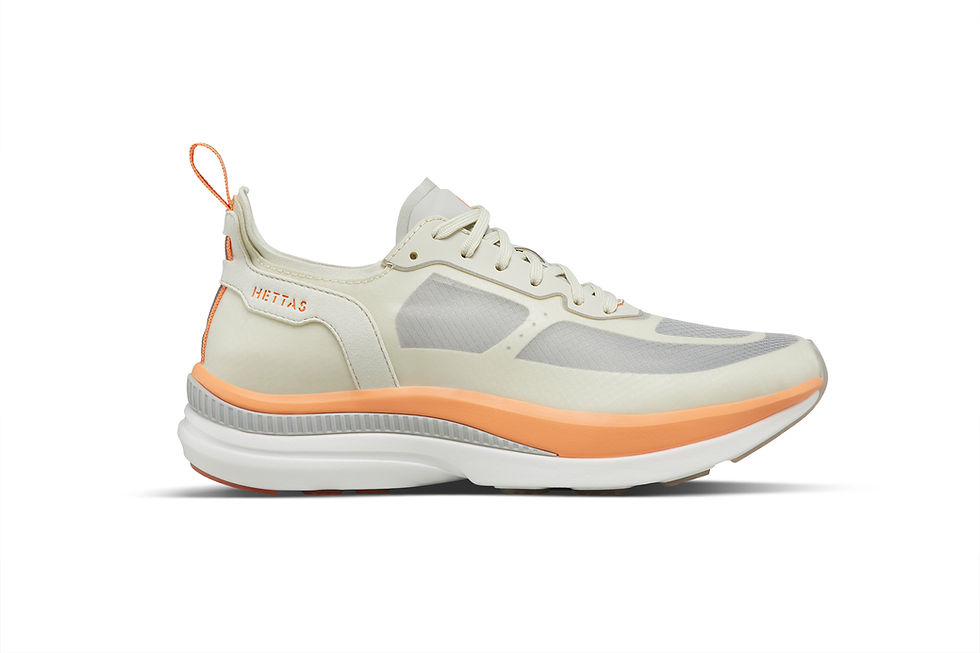

For more information and to try out your Hettas, see Hettas.ca.

For International Women’s Day, we look at the numbers behind women’s impact on our sport
BY THE NUMBERS
Size of the global woman’s sportswear market
$58 billion
Number of women expected today at Japan’s Nagoya Women’s Marathon, the largest female marathon in the world
20,000
Percentage by which women are better than men at holding a consistent pace at the beginning and end of a marathon
18.61%
Number of female participants expected at next month’s annual Sporting Life 10K
10,200
Percentage of women finishers in 2025 organized running events
53%
The year in which women were first allowed to compete in the marathon at the Olympic Games
1984
Joan Benoit’s 1984 Olympic gold medal-winning finishing time
2:24:52
Ruth Chepng'etich current women's record marathon finishing time
2:09:56
Size of the women’s running shoe market, only in the US
$2,184,486,000
Year the Tamarack Ottawa Race Weekend opened their Family Lactation and Feeding Tent
2024
In Canada, according to Statscan, the percentage of runners who identify as female
57%
World’s most popular race distance
5K
Finishers worldwide in 5K distances who represent themselves as female
59%
Length, in weeks, of the TCS Toronto Waterfront Marathon Training Program
16
Number of women who completed that marathon last year
2,700
Increase in number of women marathon finishers since the TCS Women's Training program began
26%
Year in the which the Servus Calgary Marathon began their own women’s marathon training program
2026


Alcohol and Running Performance Are Not Friends
Karen Kwan on how booze can impact your quest for PBs
I had intense brain fog and was extremely sluggish.
Standing in a snowy field in Sweden this January, where Absolut Vodka winter wheat is harvested, I’m shaking my head at this situation I’m in. I’m with the vodka brand in the village of Ahus where they produce Absolut, learning about the company and its newest launch, Absolut Tabasco, right as I’m kicking off my training block for my first Boston Marathon.
The irony that I’m in the vodka belt of Europe and have an itinerary that includes drinking Absolut Tabasco cocktails and espresso martinis, not to mention a night of bar hopping with a Stockholm-based spirits expert, right when I’ve been heavily considering whether the alcohol I consume is potentially impacting my goal to become a faster marathoner, is not lost on me.
This vodka-focused press trip comes right on the heels of running my first ever 5K race with a significant hangover. My system — full of champagne, tequila and bourbon from New Year’s Eve — made me well aware that my Resolution Run 5K the morning of January 1st was not going to be pretty. I had intense brain fog and was extremely sluggish and it made what should have been a short and easy speed workout a very rough run and a terribly slow chip time.
While I have no regrets about how much I drank on New Year’s Eve and I don’t feel guilty about the cocktails and wine I consume (somewhat) regularly, I’ve been contemplating how my drinking impacts my running. When I consider how disciplined I am with my marathon training — and my goal to get faster and stronger each year — have I been shooting myself in the foot with booze? Because while I would happily enjoy a craft cocktail every night and am not sober curious, if a zero-proof lifestyle could surely get me to a sub-3:30 marathon, I’d sacrifice my beloved spicy margaritas in a heartbeat – well, at least during each four-month training block.
Have I been shooting myself in the foot with booze?
How does alcohol impact a runner’s body?
With the nagging thought that I’m defeating my own efforts, I dug into alcohol’s impact on running and chatted with registered dietitian Megan Couturier from JM Nutrition about exactly how a lifestyle that embraces drinking socially impacts a runner’s body.
Dehydration
Alcohol is a diuretic. “It causes the excess removal of water or electrolytes from the body via urine,” says Couturier, who specializes in sports nutrition. This means booze increases your risk of dehydration, which can translate into feeling fatigued and muscle cramping.
Delayed carb and fat metabolizing
The body can’t store alcohol, so when you drink, your liver has to focus on processing it. So rather than efficiently processing fat and carbs, it’s instead putting all its attention on clearing the alcohol from your system, notes Couturier. With your body not producing glucose and effectively burning fat (which your body needs for energy to run), you can experience symptoms of feeling under-fueled and fatigued.


Consistent post-workout drinks could impair long-term muscle recovery.
Diminished recovery
If you regularly enjoy a beer or two after a run, you could be impacting how well your muscles recover. When you drink post-workout, the alcohol in your systems affects muscle protein synthesis (MPS). Your muscles, through MPS, work on recovering and rebuilding, and this process is slowed by alcohol. A systematic review on studies focused on alcohol consumption following resistance exercise published in the 2019 Journal of Functional Morphology and Kinesiology found post-exercise alcohol consumption resulted in a decrease in MPS rate and testosterone levels. This, along with an increase in cortisol levels, indicated consistent post-workout drinks could impair long-term muscle recovery.
Poor sleep
With alcohol being diuretic, you’ll be waking up through the night to go pee. Besides disrupting your sleep with these trips to the bathroom, alcohol is known to contribute to poor quality sleep (including less REM sleep). “When you sleep, your body is focusing on digesting, resting and returning to its natural state,” says Couturier. “In a dehydrated state when you keep getting up through the night, you’re not able to achieve that peak recovery.”
Weakened ability to push exercise load
When you’ve had a few drinks the night before a training run, and you’re dehydrated and have slept poorly, you’re simply not going to be able to push the volume on that run, says Couturier. In addition to not feeling able to push the intensity of your workout, you may also feel lethargic and less coordinated, which could potentially increase injury risk.
You’re simply not going to be able to push the volume on that run.
Balancing one’s drinking habits as a runner
But how much can you drink without it impacting your performance? Much like there’s no way to isolate how much faster a runner I’d be just from giving up alcohol, there’s no clear recommendation on what the tipping point is on how much you can drink before it starts impacting your training. It’s dose-dependent, says Couturier, adding that other factors, including your metabolism, genetics and gender, also play a role. That said, you don’t have to quit drinking alcohol entirely if you’re a PB-chasing runner who also enjoys alcohol. Couturier shares some tips on how to find a happy balance:
Be smart about how you’re scheduling your training and drinking. “If you have a high volume training session the following day, or a race, I would definitely recommend not consuming alcohol the night before.”
Offset your water losses. When you are drinking alcohol, drink a cup of water for every alcoholic beverage you’re consuming.
Mitigate your dehydration with electrolytes. Have an electrolyte supplement before or during your training session to mitigate fluid losses if you’ve been drinking the night before.
Prioritize recovery before you have that first sip of alcohol. Even if you love having beer after a workout, Couturier says you can wreak havoc on your body when you’re only knocking back post-run brews. “Have your protein and your carbohydrates first, and then consume the alcohol,” she says. Don't replace your post-exercise meal or snack with a beer.”
.jpg)
THE RETURN OF LEGENDARY RACHEL CLIFF
(But Not How You Think)

Rachel Cliff, former half marathon & marathon Canadian record holder, is owner of the fastest debut marathon by a Canadian female. 37 years old from Vancouver, Cliff, returning to running post achilles surgery and after the birth of Esme and Rowen, her two kids, is returning to the sport she loves. iRun’s Sabrina Young has the exclusive story on her return.
Q
Sabrina Young: First of all, I'm very, very happy to hear that you're back to running. I'm especially interested because now that you're a mom. What does that mean in your world right now?
Rachel Cliff: Currently, I have a really big question mark with regards to my achilles. I'd absolutely love to confidently say to you, ‘I'm pushing for the next Olympics and I'm coming back.’ But I'm still in the weeds of the reality of where I'm actually at and what's possible.
SY: Makes sense.
RC: My philosophy these past 4 years, basically since my daughter was born, is that — you’ve got to walk before you can run. The injury I had was incredibly severe and after surgery I literally had to learn how to walk before I could run. At this point, I'm able to run six days a week, do one long run a week, a few little fartleks, but I’m still not wearing spikes, or racing shoes, or anything like that. I'm just trying to be thankful for what I get back.
SY: Trying to be realistic.
RC: Anything short of coming back to what I had before the injury, I'll be sad, but I've also kind of had to acknowledge I had a very, very major Achilles injury and it's been a long load to return from. It’s not necessarily the kids that have stopped me but there’s no doubt going through a major surgery as a parent changes your priorities and resources.
SY: I'm sorry to hear the injury was that severe.
RC: Yeah, it was not fun.
SY: It's never fun to be injured and then you have motherhood involved and that just compounds the difficulty.
RC: It's been sad for me having to stop racing for so long. It probably looks like I had kids and have moved on but in reality my foot injury was a major factor before I even became pregnant with my first child. That’s not to say I would have been able to come back if I hadn’t had the injury — returning to sport after kids is an impressive feat, especially as the birthing parent, but, I’ve had a different hurdle to jump over.


It's been sad for me having to stop racing for so long. It probably looks like I had kids and have moved on but in reality my foot injury was a major factor before I even became pregnant with my first child.
SY: That’s an important point to make.
RC: Yes, for me it is I really believe with the right support a person can return to elite sport postpartum and it’s been sad for me that, at least this far in, I haven’t been able to to be one of the success stories - but it’s not directly connected to me becoming a mom. This injury has just coincided with when I became a parent.
SY: And now you’re also a working parent, let’s talk about your involvement with Hettas.
RC: In an indirect way it was connected to my injury: about a year into it I was meeting with a lot of different physios and specialists because the injury I had was complex and it wasn’t overly clear what was going on. It was a slog. One of the people I connected with was physiotherapist Chris Napier who works with Hettasthe to complete female-focused research studies out of the Simon Fraser University Run Lab.. He mentioned in passing that there was a local company making running shoes just for women and it piqued my interest - I’d heard a bit about how running shoes weren’t designed for female anatomy and, as a female runner with a foot injury, the idea that shoes weren’t designed for me hit close to home.
SY: Did you have a sponsor at the time?
RC: I had been on a contract with ON that was wrapping up and had been fortunate to have some good chats with their shoe design team which was an aspect of the partnership that I really enjoyed. I guess I developed an interest in the behind the scenes of running shoe design through that. Fast forward a few years later, I was at the Jerome Classic and Chris and I talked about Hettas again. They were doing a run study assessing three different versions of the same shoe to see which ones were best before they went to market and they were looking for someone to coach women for a 6-week program and he asked if I’d be interested in connecting with Hettas
Q

My philosophy these past four years is that you’ve got to walk before you can run. I'm just trying to be thankful for what I get back.
SY: You’ve achieved a lot in three years, having two children, an injury diagnosis, surgery and recovery to working with Hettas.
RC: Thanks! It’s been a period of transition for me and I feel like I’m still in it, adapting to life as a mom of two. Running wise it is a bit easier now that my daughter is in daycare and my husband can take her to school - he’ll walk both kids to her daycare drop off and I’ll run in that window. But it wasn’t always like that - the beginning was much tougher! Each child is different and with that comes its challenges, my son is a contact napper so that’s been limiting! . The parental load falls mainly on the mother in that first year and to be honest, I missed the alone time for myself, which has been a huge motivator to get back. I don't take my mobility for granted anymore.
SY: Understandable.
RC: It really helps that there have been great advances in research to encourage women to exercise through their pregnancy. Dr. Margie Davenport of University of Alberta is a leading figure in research for prenatal exercise and I referenced her work during pregnancy. It helped in my recovery and mental health to continue to run through my pregnancy, doing pelvic floor exercises and strength work. Ultimately I know being postpartum is only temporary and spending time running in Vancouver's beautiful forests is a wonderful environment to help put me in the right mind-set.


GEL-CUMULUS 28
“Energetic” is a term that gets tossed around lots with regards to new running shoes. It’s hard to sometimes quantify exactly what that means, but in the new GEL-CUMULUS 28 from ASICS, out March 1, you can feel the bounce in the shoe at first demonstration.
There’s an engine humming in the neutral everyday trainer and the FF BLAST MAX foam provides a ride that’s at once smooth and also propulsive: like Bad Bunny’s Super Bowl half-time show.
I wore the GEL-CUMULUS 28 through a variety of workouts for two months while preparing for the Tartan International Ottawa International Marathon. Though it pained me to wear the pretty white trainers in the yuck of the Toronto slush and snow — when did my running shoes get more stylish than my dress shoes? — the GEL-CUMULUS 28 held up after repeated uses and maintained their “energetic” feel.
The shoes are lightweight and comfortable, and the proprietary FLUIDRIDE™ outsole material keeps the transitions between strides smooth. I could run quickly in the twenty-eighth edition of the wildly popular ASICS model, and the durability was extremely impressive. Fast, but not flimsy. Strong, but also light enough for Fartleks and sprints.

So far, the GEL-CUMULUS 28 have held up to the Canadian winter better than my plumbing. It’s true! Because while my pipes froze, my sneakers remained cloud-like, even after being submerged for thirty kilometres in forty-six centimetres of snow.
My $145 running shoes handled the winter better than my Toronto-priced home.
The material in the GEL-CUMULUS 28 is called AHAR® LO, and it’s proprietary to ASICS and loaded in the heel, which adds to the durability of my favourite new shoes.
As marathon runners, but even as runners of any distance — especially outdoors in the muck — we need to use a shoe rotation to get the best from our workouts. At $145, it’s hard to imagine who the runner is that wouldn’t find benefit in the breathable, adaptive GEL-CUMULUS 28.
The GEL-CUMULUS 28 has an 8mm heel drop and weighs 7.9 ounces and, when you wear them at a BlackToe Running Wednesday workout, they’re guaranteed to generate oohs and aahs.

For the past two years, ASICS has been awarded Brand of the Year in the annual iRun Golden Sneaker Awards, which are voted on by our database of more than 300,000 runners.
Launched in Japan in 1949, the company is at the vanguard of running technology. From the $300 METASPEED RAY, worn by the great Natasha Wodak, to the $145 GEL-CUMULUS 28, worn by me, a 51-year-old schlub, ASICS continues to produce the shoes most popular with iRun.
Later this month, we’ll reveal our test drive of the SUPERBLAST™ 3, which will be in stores on March 1. It’s yet another dependable, fairly priced, ethically-made technological masterpiece from ASICS, the shoe company that can seemingly do no wrong.
To conclude, the GEL-CUMULUS 28 by ASICS, which dopped March 1, is a shoe every runner will love.
For more information, click here.


.png)

The Chilled-Out Approach to Elite Marathon Training
At 42, Polly Cunes, the Calgary mother of two returns to the Boston Marathon — this time in the elite field, carrying a new mindset shaped by surgery, maturity and a deep love for the process, writes Anna Lee Boschetto
.jpeg)
Polly Cunes is not the same athlete who first lined up at the Boston Marathon more than a decade ago. Back then, she was chasing times, splits and external validation. This spring, the 42-year-old runner, physical education teacher and mother of two will return to Boston not just older and stronger, but transformed, stepping onto the start line in the elite field, shoulder to shoulder with some of the best marathoners in the world.
“It doesn’t seem real,” she says. “Running in the pro field in a world major was never on my radar, never thought I would be capable of. To say it was a dream is underestimated.”
The possibility didn’t arrive with fanfare. It started quietly, as a flicker of curiosity.
“It first came as a seed in my mind when I saw another runner, Melissa Pearlman. She was 42 and got in to run Boston in the pro field and her personal best was 2:42. This time last year I was 2:44 and I thought, maybe, I could do that.”
The idea lingered. She brought it to her coach. She allowed herself to imagine something that once felt reserved for someone else.
At Boston, masters athletes who hit the qualifying standard can check a box in September asking to be considered for the pro field. Then comes the waiting.
“You don’t know if you get in until December,” Cunes explains.
In the meantime, she raced in Chicago and lowered her personal best again — down from 2:41 — and emailed organizers with the update. The acceptance came at the end of December, during what she admits was a mental lull.
“It has lit a fire, and I have never been more excited to train.”
.jpeg)
When injury forced her to step away from running, the loss reshaped her relationship with the sport.
Post-Surgery Perspective
The fire carried her through a Calgary winter, through dark mornings, one kilometre after another. She was parenting two children, balancing work, and managing logistics while meanwhile, the fire never disappeared. In fact, her motivation sharpened.
“I usually enjoy my training blocks, but parenting in winter, it’s tough,” she says. “But now with Boston, I have the best ever WHY in my training. It doesn’t mean I’m going to be pumped every single run, but I’ve never had more excitement.”
There’s a clear dividing line in her career: before knee surgery for a torn ACL and after. When injury forced her to step away from running, the loss reshaped her relationship with the sport.
“When I had my knee surgery, and running was taken away from me, it changed the way I look at it,” she says. “There’s post-knee surgery and pre-knee surgery. What I got out of it was that step back and change of mindset. There’s a deeper appreciation for it.”
Before surgery, she was rigid, attaching identity to numbers and pushing easy runs too fast because she believed that’s what a serious runner should do.
“I set these expectations of myself that were not sustainable or healthy.”
Now she laughs at the irony: her easy runs are slower than ever — and she is faster than ever.
“I chilled out,” she says. “I’m more laid back and I don’t feel like I have to run any number of miles. My easy miles are way slower than they were back then, even though I’m a faster runner.”
The shift hasn’t dulled her ambition; it has refined it.
“Now I find enjoyment in the day-to-day training and spend less time on my finish time and needing to prove myself.”
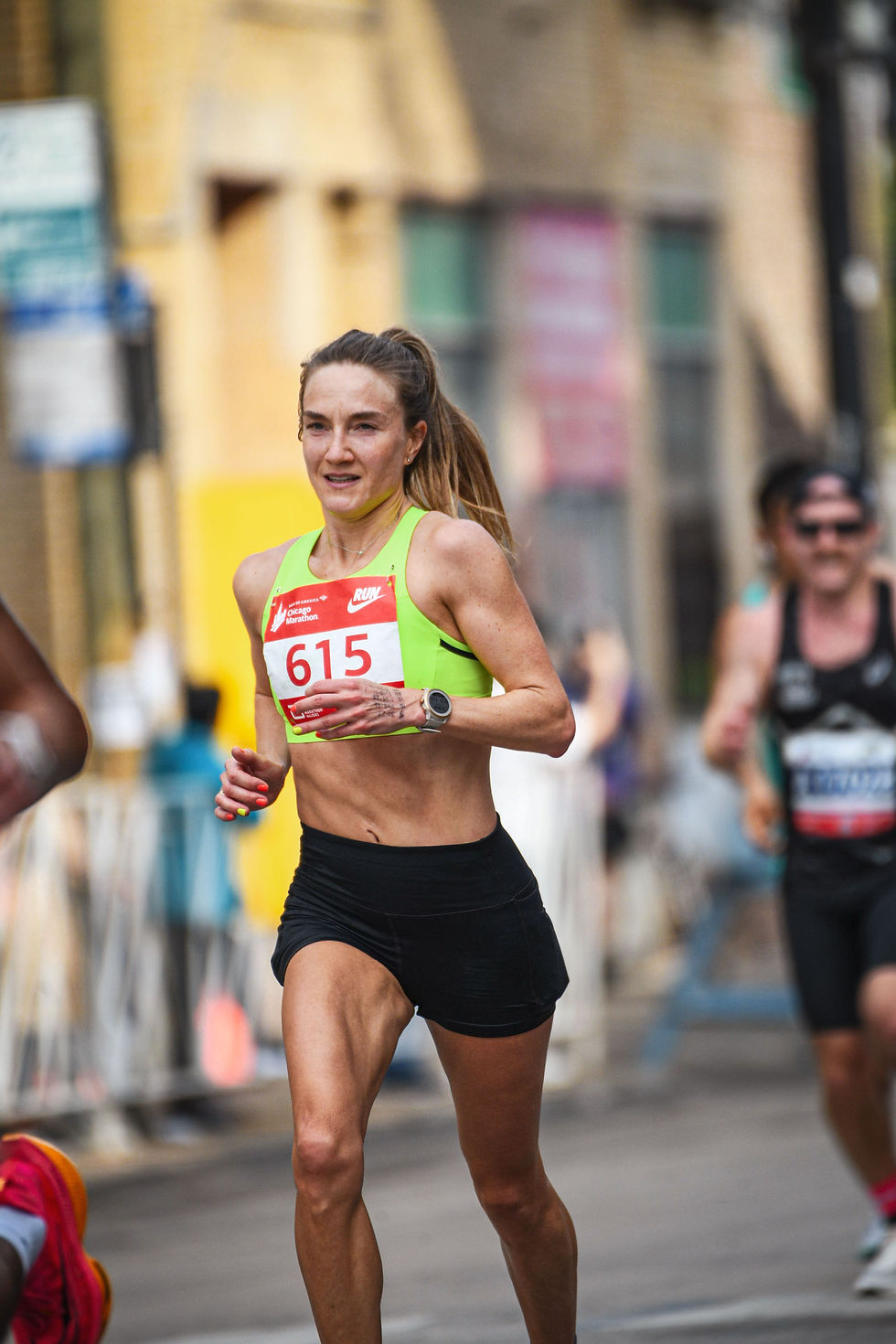.jpeg)
“Now I find enjoyment in the day-to-day training and spend less time on my finish time and needing to prove myself.”
Belief and the Breakthrough
Two years ago, she changed coaches, a move that proved pivotal.
“There is no way I’d be here without either of my coaches. Now, he believes in me more than I do.”
From their first conversations, he spoke matter-of-factly about a 2:39 marathon. At the time, Cunes had run 3:04 and didn’t yet believe she could break three hours.
“Having a coach who believed in me, and he isn’t saying this arbitrarily, he’s figured out the formula, that’s been huge,” she says.
The formula included climbing to 140K each week, with a sharper edge: one major workout each week and a deliberate emphasis on faster paces.
“In a year, I got to workouts where I never knew I could be.”
She recently flipped back through old training logs and barely recognized the mindset. The physical gains are measurable; the mental growth is just as powerful.
The Working-Mom Equation
Cunes is quick to acknowledge the ecosystem around her.
“I’m not doing this on my own. I have a lot of support.”
Busy, she has learned, doesn’t have to mean impossible.
“It’s changing it to, yes, I’m busy, but where can I fit it in? Generally, there will be time to fit it in if you want it badly enough.”
With older kids and a well-practiced routine, she’s found her rhythm. She also understands that priorities shift. Running, for her, amplifies everything else.
“It’s that sense of accomplishment. When you’re getting up early and running the miles and grinding out a workout, you have a little extra pep in your step to go through your workday.”
.jpeg)
“It’s that sense of accomplishment. When you’re getting up early and running the miles and grinding out a workout, you have a little extra pep in your step to go through your workday.”
The Prize Is the Start Line
When she lines up in Boston this year, her bib number will signal something unmistakable. She remembers breaking 2:50 and feeling proud, studying bibs and knowing what they represented.
“When you look at someone’s bib number you know how fast they are. I wanted to go back to Boston with a faster bib.”
This time, her bib will have her name, among women she has long admired, some of them Olympians.
“This is kind of my Olympics,” she says.
Not because of medals or podiums, but because of what it represents. Her coach will be there. Her boyfriend will be there. The plan is simple and profound: “To take in the whole weekend and breathe it in as an experience.”
She still has a bold goal for the race, ambitious enough to scare her, but the pressure has eased.
“When I’ve run others, there is a time I want to make and the prize is the finish line. I feel the prize here is at the start line. If I make the goal I’ve set, that’s the craziest icing on the cake. But I don’t feel a lot of pressure.”
At 42, Polly Cunes isn’t chasing a number. She’s not trying to prove she belongs. She’s standing fully inside a moment she once couldn’t imagine possible. She’s aware of the miles, the setbacks, the early mornings and the growth that carried her here.
The real victory isn’t waiting on Boylston Street.
It’s already there, on the start line.
.jpeg)


.png)

How to Stage a Marathon in Canada’s Largest City
John Shep goes live in the Event Operations Center of the TCS Toronto Waterfront Marathon
In the Tao of Pooh, Benjamin Hoff writes about “the most important term of Taoism: Tz’u, which can be translated to ‘caring’ or ‘compassion’ and which is based upon the character for heart. In the sixty-seventh chapter of the Tao Te Ching, Lao Tzu named it as his ‘first treasure.’”
This past Fall, I saw what goes into staging the TCS Toronto Waterfront Marathon, housed in the spectacular TCS Innovation Hub. For this very publication, I wrote an article in November 2024 about Canada Running Series (CRS) Event Director Charlotte Brookes being the Wizard of Joy. This was now my chance to peek behind the Wizard’s curtain and see how the magic is made.
I have to tell you, there is no big secret, simply Tz’u.
This is Canada’s largest marathon and has the infrastructure to support it, because every October, the TCS Toronto Waterfront Marathon is the center of the running universe. A little before 6am on October 19, 2025, I walked into a room of running rockstars and over the next eight hours, I witnessed, watched and listened to the magic of operating the gold standard of Canadian running events.


Every cup, every one-way street, every streetcar, every barricade, every volunteer and spectator, every officer, every yoga activation at the finish line is considered.
However, the critical piece is that while it is considered by event director Charlotte Brookes, it was not managed by her. In the EOC, there are Canada Running Series leads for each section of the course, along with one for Volunteers, for Social Media, for Medical, for Security, for Customer Service and for the Start and Finish areas.
Additionally, they have representatives from the Toronto Police, Toronto Paramedic Services and the Toronto Transit Commission (TTC) present. There is even a mysterious figure with the ability to control the traffic lights in the city of Toronto – probably the coolest of all these jobs!!
More importantly, Charlotte has good people at the helm of each of these major roles. When I mentioned running rockstars, it was with a bit of poetic license, but just barely.
The Canadian running family converges on this one magical weekend for the TCS Toronto Waterfront Marathon, including Anna Lewis, the Race Director from the Around the Bay Road Race; Michelle Pauls, Race Director for Hamilton Marathon Road2Hope; John Halvorsen, former race director of the Ottawa Marathon; the ever-present and engaging Kevin Jones and the Odyssey Medical team; and Dana Bee, owner of Chiptime Results. And this doesn’t include the on-course leads, Michael Brennan, Albert Ngai and Cory Freedman (race organizers and directors in their own right), along with Canadian running legends Krista Duchene on the live stream, Reid Coolsaet organizing the elite field, and Kate Van Buskirk on the finish line interviews.


“What is the point of hiring smart people, we asked, if you don’t empower them to fix what’s broken?”
Charlotte and the Canada Running Series are magnets for the good people network.
In chatting with Dana Bee, who was taking care of the Canada Running Series’ social media accounts for the day, she reflected, “Charlotte and her team are organized, passionate and deeply committed. It felt like watching a well-oiled machine powered by the race community itself – busy, seamless and welcoming, with industry professionals from all over coming together in the EOC and out on the route to support one another for one common goal: the runners.”
So yes, part of why the Canada Running Series can put on a world-class event is the quality of individuals involved, but it’s also in how Charlotte cares for and trusts her people. This starts with making sure that each of them have breakfast and lunch (I have to tell you, the spread puts aid stations to shame!) and extends to how she empowers and trusts the people she has put in these positions, never micro-managing them.
Pixar Animation’s founder Ed Catmull in Creativity Inc champions the path to trusting, strong and collaborative teams with the simple question: “What is the point of hiring smart people, we asked, if you don’t empower them to fix what’s broken?”
In doing just this, empowering her people, Charlotte ensures that these individuals know that they can come to her with problems, but also that they can take care of the problems themselves.
A couple of hours into the race, there were two nearly simultaneous issues on course.
First, as the TTC began to open transit lines back up, I watched Charlotte listen to a conversation between the TTC Diversion team and the Aid Station Lead. They were trying to determine whether or not the athletes had made it through and if they could again start a specific streetcar.
Charlotte listened, chatted briefly to the TTC team, and then trusted them to divert the streetcar.
Then, at 9:58am, there was a potential arrest on site as an individual had become dehydrated and agitated. Both Charlotte and I watched as the course lead confirmed the individual’s bib number and as the runner was supported on-site and in the EOC by Odyssey Medical and Toronto Paramedic Services. After they confirmed the individual was conscious, it did not stop there. The paramedics worked with the rest of the EOC super-friends to navigate race and road closures, ensuring the fastest possible treatment for this individual before handing it off to the local medical services.
Fortunately, this athlete was able to recover on course, but it was amazing to watch the coordination – and care – by everyone involved. Charlotte certainly could have jumped in if needed, but by giving space, she gave her people confidence.
“there are no egos here, all relationships.”


A key element to the magic of the Canada Running Series is that they are always giving back, paying it forward. This was evident as the invitation to both Nick Bitel, Chief Executive of the London Marathon Group, and Steve Dowler of the Run Calgary Board of Directors to shadow and observe the EOC. It was Steve, who is also a Staff Sergeant with the Calgary Police Service, who I credit for the spirit of this article. He was impressed by the collegiality of each of these diverse teams, coming together for the common good: “there are no egos here, all relationships.”
The EOC hummed throughout the day but was never frenetic. As a journalist preparing for this article, I could have been torn. If I was looking for a click-bait story, which would have come from a war room debacle or a major incident on the course: this didn’t happen. Instead, I got a good story. The over 20,000 athletes and Canadian record-setting 7,538 finishers in the marathon event may never see this side of the magic, but they felt it. The citizens who are assisted through the road closures and race traffic felt the magic. And one specific trio of children, who were separated from their family, felt the magic directly.
As the bulk of the half-marathoners were finishing, Charlotte and the Toronto Police representatives got word of three siblings who were lost, having been spectating the race and cheering on their mom. The children had found a local police officer, who contacted the EOC. Charlotte then found mom’s name through the children, confirmed her bib and that the father was the emergency contact, and contacted both parents to tell them where to meet the on-site officer and their children.
A little added excitement for one family, but a testament to the fact that every single individual around the TCS Toronto Waterfront Marathon is considered. And as a result, each feels the magic, the care, the joy, the compassion – the Tz’u – of Charlotte Brookes and the Canada Running Series team.
John Shep is an Ontario-based ultrarunner, teacher, and the host of the Athletics Ontario Running Podcast.
